
Supplier price hikes and delayed shipments—Chinese PV industry players’ "630" anxiety disorder

"This year's rush to install equipment by June 30 is even greater than in previous years." A representative from a photovoltaic power plant investment company voiced his complaints to PV Mén. Meanwhile, rumors that the June 30 deadline might be postponed have begun to circulate quietly. Recently, the China Photovoltaic Industry Association convened an industry situation symposium on "630" in Beijing. Reportedly, during the event, insights shared by various companies and a consolidated overview of the current industry conditions will be compiled into a document, which will then be forwarded through the Ministry of Industry and Information Technology to relevant government departments. In fact, in the very first drafts of last year's proposed photovoltaic electricity price guidelines, the adjustment milestone was set at "930." It wasn't until the final draft and the official document that the date was shifted to "630"—a change that initially drew less attention within the industry, as everyone was primarily focused on the evolving electricity tariffs rather than the specific timing of the adjustment.
Supplier suddenly hikes prices
Several leading component companies have openly stated that the rush to install systems before June 30 left their products "in high demand—so much so that even a single watt became hard to come by"—and highlighted numerous instances of contract breaches. Industry giants like Canadian Solar, LONGi Solar, JinkoSolar, JA Solar, and Leye are all operating at full capacity. Yet, despite this, sales teams continue to face relentless pressure from customers demanding immediate delivery. One sales representative jokingly remarked, "Because of the scramble for installations before June 30, manufacturers have essentially become the clients. Our company has even assigned dedicated personnel to monitor component suppliers closely, ensuring we secure shipments on time—because if we let our guard down, competitors will snatch up those precious supplies faster than we can blink. Some companies are even resorting to offering premium prices just to get their hands on the limited inventory."
A sales representative from a component company revealed, "The current issue is that even full-payment orders can’t secure the products—several top-tier component manufacturers have already canceled hundreds of megawatts worth of orders. With production capacity fully booked and no room for additional projects, there’s simply no surplus supply available, whether it’s monocrystalline or polycrystalline modules."
Even at high prices, we still can’t get the components delivered on time. Han Liang, head of a power plant investor with a capacity exceeding GW (a pseudonym used at the interviewer’s request), openly shared their struggles with PV Makers: "We purchased modules from a Jiangsu-based component company in April, but by May, they were already unable to meet our supply needs. As a result, we had no choice but to place an order directly with a well-known monocrystalline manufacturer." The quoted price for the 280-watt monocrystalline module is 3.45 yuan per watt—though it’s admittedly high, we have no choice but to accept it. "Even so, they initially said supplies would be delivered by May 25, but soon after, they announced a delay—pushing it back again and again. Now, their latest response is that deliveries will begin on June 10. We’re deeply concerned about whether the components can be installed on time."
Besides components, inverters, packaged substations, and other equipment are also facing supply shortages. Sungrow Power has "specifically assigned personnel from the project owner's side to monitor inventory directly at the supplier factories, while nearly all sales inquiries have been routed back to headquarters to assist in tracking deliveries alongside customers."
According to several corporate sales representatives, their company has already nearly met its sales and profit targets in certain regions. As Han Liang put it, " Many equipment suppliers have already earned a year's worth of revenue thanks to this 630. That's it. In the second half of the year, we'll find it very difficult to work with these suppliers who are "taking advantage of the crisis." 。”
Not only are components experiencing price hikes, but inverters, combiner boxes, transformer substations, and even engineering contractors are all increasing their prices. Han Liang says that at their project site, some combiner box suppliers have already raised prices by as much as 2 cents per watt. Meanwhile, engineering contractors aren’t just implementing temporary price surcharges—they’re also demanding full payment before June 30, threatening delays or even outright refusal to complete the project on time unless this condition is met. "It’s now too late to switch suppliers; we’re left with no choice but to accommodate their demands as best we can." What bothers Han Liang most, though, is the company responsible for the external line construction—these entities are typically third-party subsidiaries of local grid companies. "Our contract originally stipulated a 20% upfront payment, with the remaining 70% due after the project concludes. But as we approach the critical stage of grid connection, they’re suddenly insisting on full payment immediately, even requiring us to pay the warranty deposit in advance."
Even with rising costs for components—such as brackets, combiner boxes, transformer stations, and construction fees—Han Liang believes that the electricity price of 0.98 yuan/kWh in the eastern region can still be sustained. However, if investment costs continue to climb, there’s a risk that by June 30th, when the tariff could drop to 0.85 yuan/kWh, the project will inevitably turn into a loss.
Meanwhile, some power plants are facing difficulties—even though their components have already arrived—due to a shortage of mounting structures. Meanwhile, the recent nationwide environmental inspection campaign has added fresh pressure to the rush to complete installations by June 30th.
The shortage of scaffolding—China's strictest-ever environmental inspection campaign
Han Liang Company’s numerous projects have generally been hampered by a severe shortage of scaffolding supplies. "The recent nationwide environmental inspection campaign launched by the Ministry of Environmental Protection has left most galvanizing plants in Tianjin and Hebei struggling to stay operational." According to reports, the ministry mobilized 5,600 environmental enforcement officers and plans to conduct 25 rounds of inspections over the course of one year across 28 cities in the Beijing-Tianjin-Hebei region and its surrounding areas. During the month-and-a-half period from April 7 to May 19, the inspection teams rigorously reviewed 12,000 enterprises—among which over 8,000 were found to have environmental compliance issues, including a significant number of scaffolding manufacturers.
630 encountered the most robust environmental inspection campaign in history. The closure of galvanized steel plants in Hebei and Tianjin has led to a tight supply of mounting brackets. Even without environmental concerns as the underlying cause, bracket supplies remain scarce—so much so that Aikang, the country’s largest manufacturer by capacity, is now running its bracket factories around the clock to meet demand. According to one bracket producer still operating, their entire production capacity is fully booked, and prices have even edged up slightly.
Han Liang’s project recently faced a challenge when the price of mounting brackets surged—his general contractor had previously secured supplies from two vendors. Unfortunately, one of them was ordered to halt production during the recent environmental inspection, while the other, though able to fill the resulting gap, demanded a price increase of 1,500 yuan per ton. In Han Liang’s view, the comprehensive environmental oversight campaign has emerged as one of the most significant factors pressuring this year’s “630 rush installation,” directly impacting both construction timelines and the overall quality of project installations.
Another power station investor is facing an even trickier problem: Their bracket supplier, after delivering 50% of the order, suddenly demanded stricter payment terms—only agreeing to ship the remaining brackets after full payment was made. However, the quality of the brackets didn’t meet the contractual specifications; not only was the amount of steel used lower than agreed upon, but there was simply no alternative supplier available. As a result, they had no choice but to install the substandard brackets as planned.
Land, power grids—problems keep piling up one after another.
In addition to products, land and the power grid are also holding back investment developers from accelerating project installations at various power stations. Several projects undertaken by one particular power station investor have already run into land shortages—land initially planned for construction turned out, upon entering the site, to have been inaccurately surveyed. As a result, the geological conditions of some plots were found to be unsuitable for installation, further exacerbating the scarcity of available land.
“This time, the installation rush was given far too little time—targets were only issued last July and August. Many of the preliminary procedures simply can’t be completed within half a year,” revealed a power plant developer. “In fact, several key documents might not even be finalized until after the project is connected to the grid.”
Han Liang noted that, unlike the 630 policy of the past two years—when grid companies in many provinces weren’t as strict in their management, allowing projects to be considered “connected” even if only part of them was integrated—this year, grid operators across regions are demanding full-capacity grid connection. Back in the 2016 630 rush installation period, Henan’s grid company wasn’t particularly rigorous in its oversight, which led to a surge of projects ramping up nighttime work in early July to expedite the installation of PV modules.
According to a rough overview and statistics from PV-Monitor, nearly 1 GW of modules from the 2016 "rush installation" projects targeting June 30 were not fully installed until July or even August nationwide.
"I'm not sure how strict enforcement will be this year—Shandong and other provinces are among the regions with particularly rigorous implementation," Han Liang noted. "Some projects definitely won’t be able to connect to the grid at full capacity, so we’ll have to explore every possible avenue to ensure they pass grid-connection inspections."
Is this year's 630 really reasonable?
First, let’s revisit the timeline for the allocation of provincial targets in 2016. In early June 2016, the National Energy Administration finally issued the annual photovoltaic power generation capacity allocation plan for each province. However, by December, provinces like Liaoning, Ningxia, Shaanxi, and Guizhou had yet to finalize their allocations. Below is a table compiled by PV News at the beginning of last December, detailing the allocation schedules for each province:
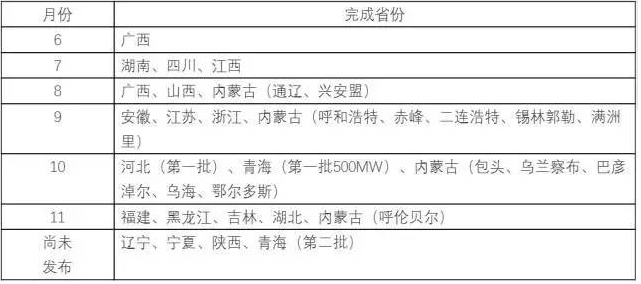
As shown in the image above, some regions such as Jilin, Heilongjiang, and Inner Mongolia only completed their target allocations in November.
In regions north of Shandong, the winter construction period spans from November to the end of March of the following year. As a result, areas such as Liaoning, Jilin, Heilongjiang, parts of Inner Mongolia, and Shaanxi will face the challenge of being unable to start construction during the winter months. In these regions, construction can only resume after March 2017, leaving project owners with just about three months to complete their projects. This tight timeline will inevitably impact and constrain various aspects, including quality control during accelerated work and product procurement. Moreover, the external line connection works for power stations represent another critical bottleneck that could jeopardize the timely completion of the project schedule.
Under the previous policy framework, in provinces following the "first come, first served" approach, it typically took about six months from initial project interest to the project reaching basic completion. However, in the current environment, development companies have become increasingly cautious. "Most projects are either legacy developments from earlier stages or acquired assets—there’s very little new project pipeline being built from scratch at the early planning stage. Given the uncertain policy landscape, companies are now reluctant to launch fresh projects, as they’re deeply concerned about securing the necessary land-use indicators."
Han Liang believes that the current industry situation of rushing to secure projects by June 30th is placing significant management pressure and increasing cost burdens on investing companies. "The approval certificates are valid for only two years, yet from the moment the targets are issued until grid connection, companies are given less than a year—a clearly unreasonable timeline. In many regions, target allocations weren’t even finalized until December 2016 or January 2017, yet grid connection was already mandated by the end of June."
"This year's 630 installation rush is also larger than in previous years. The price cuts this time are quite significant, prompting previously delayed, unstarted projects to be completed urgently at this very moment. Moreover, both last year’s photovoltaic poverty alleviation projects and the additional capacity expansions were substantial, resulting in an overall surge in installed capacity compared to the past. I estimate that it could reach 13–15 GW," said Han Liang, whose analysis is grounded in his extensive experience—his company alone has about 500 MW of projects scheduled for rapid deployment."
In this context, some companies have simply given up on rushing installations. A well-known power plant developer, for instance, had a hundreds-of-megawatts distributed project in a region of eastern China—but ultimately decided to complete only one portion of it by June 30. Meanwhile, insiders at another prominent company reveal that even managing to connect one-third of their GW-scale distributed PV project to the grid by June 30 would already be considered a positive outcome.
Grid workers in a certain area of Jiangsu recently showed industry insiders the grid connection application forms their power company had received. Pointing to the list, which included dozens of projects, he remarked, "Only about half of these projects will manage to connect to the grid before June 30."
Faced with rumors of the deadline being pushed back to 7:30 or 8:30, Han Bing remained unfazed. "We’ll still strive strictly according to the original grid-connection target of 6:30—but frankly, we hope this kind of thing doesn’t happen again. If photovoltaics continue to develop this way, everyone will lose confidence."
During the installation rush, even outdated production capacities that should have been phased out were fully utilized—perhaps making them the real winners of this surge. "The money we earned this time will cover our operations for an entire year."

The pressure of China's photovoltaic industry on June 30 can be felt in the chart below:

Related News

Add: No. 22 Tengren Road, Shunyi District, Beijing
Email: info@bjhpy.com
Consultation Hotline:
86-010-60480298

Follow us
Contact:
Email:
Tel:
WeChat:
在线客服添加返回顶部
右侧在线客服样式 1,2,3 1
图片alt标题设置: Helpyou New Energy
表单验证提示文本: Content cannot be empty!
循环体没有内容时: Sorry,no matching items were found.
CSS / JS 文件放置地