
Every household in this village has installed solar panels, increasing each family's annual income by 4,000 yuan.
Starting from March 1, 2013, the State Grid has fully supported the grid connection of distributed energy resources, implementing a policy of "free access and full purchase." As a result, "selling electricity back to the state" has become a growing trend in the field of new-energy applications. Riding on this favorable policy momentum, the photovoltaic industry has flourished across Weihai City. Last year, the number of distributed power grid connection services processed by Weihai Power Supply Company surged by 530% compared to 2015, showcasing an explosive growth trajectory.
Starting today, Weihai Evening News launches a series of reports titled "Observing Weihai's Photovoltaic Industry," covering everything from the promotion of residential solar power systems to the development of large-scale industrial PV projects, offering a comprehensive look at Weihai's thriving photovoltaic sector.
In the future, whether solar photovoltaic panels can become as widespread and integrated into everyday life as solar water heaters is a question that this emerging industry is prompting as it continues to evolve.
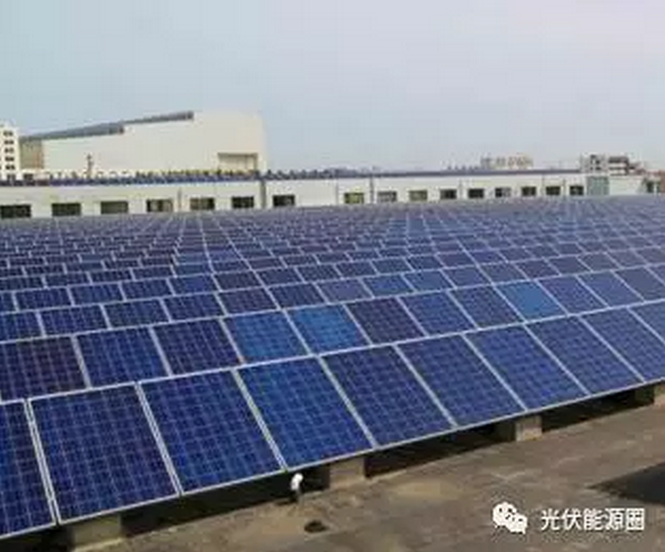
Village Collective Photovoltaic Power Generation Project

Villagers record the daily power generation in a small notebook.
Last year, 33 households in Gangdong Village, Gushan Town, eagerly rushed to install photovoltaic panels.
"Photovoltaic Village" Earns 4,000 Yuan Per Household Annually from Electricity Sales
On the morning of April 9, Xie Xiurong, a villager from Jiandong Village in Gushan Town, Jing District, Weihai City, once again checked her household electricity meter—and was delighted to see the reading: 1,031.22 kilowatt-hours. This means her small rooftop photovoltaic power station has earned her more than 1,000 yuan in income. In Jiandong Village, there are 32 other households like Xie Xiurong’s, who have installed photovoltaic panels on their own homes.
Thanks to the village's collective economic 10,000-square-meter-plus photovoltaic project, combined with solar power stations installed at 33 villagers' homes, Jiandong Village has earned the title of Weihai's "Number One Photovoltaic Village." But how has the growth of the PV industry transformed the daily lives of the villagers today?
Roofs of 33 households can generate electricity.
On April 9, the reporter visited Gushan Town in the Economic Zone. From the village’s appearance, it seemed somewhat different from ordinary villages—many residents had added a touch of deep blue to their red-tiled roofs, creating a unique and eye-catching scene.
Those deep-blue roofs are the result of solar photovoltaic panels covering the original red tiles. In this village, there are a total of 33 households like this.
At 63, villager Shao Hua has developed a daily habit: every morning, she checks her household electricity meter and records the amount of power generated. From December 1 last year to April 9 this year, her rooftop photovoltaic system produced a total of 1,098.27 kilowatt-hours of electricity.
On the flat roof of Shao Hua's house, a row of solar photovoltaic panels is neatly arranged, echoing the solar panels on several neighboring homes in the distance.
Shao Hua and her husband, Zou Benling, are both down-to-earth farmers who make a living by cultivating just two acres of land. Speaking about their household photovoltaic power project, Shao Hua explained that it all started because everyone saw the potential of the PV industry—villagers voluntarily signed up and even came together to lend a hand in getting it off the ground.
Last year, the enthusiastic response from villagers signing up to install photovoltaic power stations remains vividly etched in the memory of Zou Jingli, the Party branch secretary of Dong Village. "The village has nearly 300 households, and over 60 signed up at once. However, due to limited capacity in the distribution system and installed equipment, we could only select 30 households in the end."
Several villagers who weren’t selected refused to give up, insisting that installation was essential—and they even came to see Zou Jingli every day. In the end, with no other choice, the village added three more spots.
Each household can earn 4,000 yuan per year from electricity generation.
Why are villagers rushing to sign up for building household photovoltaic power stations? It all starts with the investment return rate of these solar power systems.
Take Shao Hua's household as an example: Based on the benchmark grid-parity price of 0.98 yuan per kilowatt-hour for photovoltaic power plants in 2016, plus a provincial fiscal subsidy of 0.05 yuan per kilowatt-hour, the total revenue from selling electricity under the full-grid model comes to 1.03 yuan per kilowatt-hour. Currently, Shao Hua's rooftop solar system has generated a total income of 1,131.2 yuan.
Investing in a photovoltaic power station like this requires an initial capital of 25,000 yuan. Given our city's sunshine conditions, Based on the system's average annual power generation of 4,200 kilowatt-hours, the total contracted price for the full-feed-in tariff model in 2016 was 1.03 yuan per kilowatt-hour, resulting in an annual revenue of 4,326 yuan. This means the investment can be recovered in approximately 5.8 years.
If you calculate the return on investment, after the photovoltaic power plant is connected to the grid and a power-purchase agreement is signed with the national grid, the national subsidy rate remains unchanged for 20 years. According to the installation company, the current lifecycle of this photovoltaic system exceeds 20 years. Calculated over a 20-year usage period, this photovoltaic power station can generate 84,000 kilowatt-hours of electricity, yielding an income of 86,520 yuan—resulting in an annual investment return rate that exceeds the initial one-time investment of 25,000 yuan. 17.3%.
Of course, these figures are based on ideal conditions—any scenario where the photovoltaic panels age too quickly, or where sunlight exposure remains consistently poor over time, could reduce the investment return rate.
"I think it's better than just saving the money—so I went ahead and signed up," Shao Hua said.
Now, when villagers who’ve installed photovoltaic panels meet and exchange greetings, they can’t help but "show off" how much electricity their systems are generating. According to the signed contract, they’ll receive their first payment for selling electricity around June of this year.
Village-level collective photovoltaic project generates annual revenue of 800,000 yuan.
Around 10 a.m. on April 9, Zou Jingli opened his computer in the office to check the day's electricity revenue. The village collective's newly built photovoltaic power station now generates approximately 3,000 kilowatt-hours of electricity daily, translating to about 80,000 yuan in monthly electricity sales income.
When it comes to the origins of the village's photovoltaic project, it all began with a report published by our newspaper back in 2013.
At the time, the Weihai Evening News published a report titled "Roof Equipped with a 'Power Plant': Resident Who Installed Solar Panels on His Balcony Becomes the First in the Community to Sell Electricity Back to the State," detailing how Dong Xiangqian, a resident of Zhangcun Town in Huancui District, set up a residential solar power system on his own balcony. Intrigued by the story, Zou Jingli took it upon himself to track down the community's pioneering solar installer. After successfully connecting with him, Zou Jingli grew increasingly fascinated by the potential of solar energy projects.
Dongcun is located in the central area of Gushan Town. The village doesn’t have much land, and with limited resources to boost its economy, Zou Jingli believes that a photovoltaic project holds great potential.
The village collective’s photovoltaic power station is installed on the roof of a local enterprise—over 10,000 square meters of rooftop space entirely covered with solar panels. After a rainstorm on April 7, the dust on the panel surfaces was washed clean, revealing a striking deep-blue glow as they reflected sunlight back at the sky. Reporters learned that Dongcun Village invested 4 million yuan in this photovoltaic project, and after just one year of operation, last year’s electricity sales already generated an impressive revenue of 800,000 yuan.
"Now that the village collective has a profitable project like this, they’re feeling more confident—and as a result, the benefits distributed to villagers during holidays and festivals are becoming increasingly generous," Zou Jingli proudly told the reporter. This year, the village plans to reinvest another 2 million yuan to launch an additional photovoltaic project, further boosting the village’s growing solar energy industry.
Related News

Add: No. 22 Tengren Road, Shunyi District, Beijing
Email: info@bjhpy.com
Consultation Hotline:
86-010-60480298

Follow us
Contact:
Email:
Tel:
WeChat:
在线客服添加返回顶部
右侧在线客服样式 1,2,3 1
图片alt标题设置: Helpyou New Energy
表单验证提示文本: Content cannot be empty!
循环体没有内容时: Sorry,no matching items were found.
CSS / JS 文件放置地