
Building-Scale Solar Direct-Power Solutions
Building-integrated solar direct power solutions
1 • Project Background
As 3060 The goals of peaking carbon emissions and achieving carbon neutrality have been proposed, emphasizing that energy conservation, emission reduction, and the utilization of new energy sources are key strategies for overall building energy efficiency.
Notice on the Implementation of Beijing Municipal Standard "Energy Efficiency Design Code for Residential Buildings," Jing Gui Zi Fa [ 2020 〕 432 Document No., New Construction 12 Optional solar water heating and solar power systems available below this level, 12 Requirements for installing solar power systems in buildings above a certain floor level.
- Solar Power Generation Solutions
Architecture Photovoltaic power generation consists of solar modules, controllers, inverters, energy storage batteries, and more. Rooftop photovoltaic power generation and BIPV Wait, this falls under the category of building-integrated photovoltaics. Based on current development trends and technology, solar power systems are categorized into the following four types:
1 ) Solar off-grid power system 2 ) Photovoltaic Grid-Connected Power Generation System
3 ) Solar-powered microgrid power generation system 4 ) Solar-powered direct current system
These four solar power systems have different applications, advantages, and disadvantages:
1 ) Solar off-grid power system It consists of key components such as solar panels, a controller, an inverter, and energy storage batteries. The system works by converting the electricity generated from sunlight into power stored in batteries via the controller, and then using the inverter to convert this stored DC power into AC current, which can be used to supply devices. On cloudy or rainy days, when battery power and solar generation are insufficient, the system can automatically switch over to grid electricity or even a diesel generator (as auxiliary power) to keep devices running smoothly.
Advantages Output power is stable, voltage is steady, and there are no harmonics—no need to handle grid connection procedures.
Drawbacks: Independent power systems suffer from low solar energy conversion efficiency, poor system efficiency, high overall costs, and short lifespans for energy storage batteries, which require regular replacement.
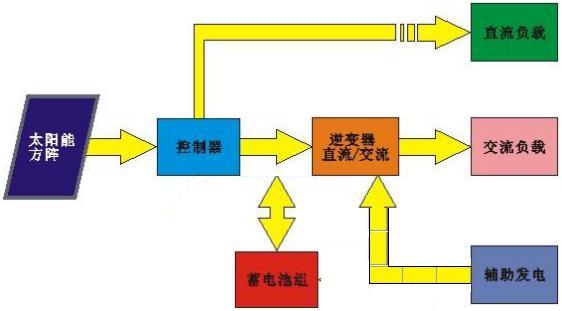
System Diagram 1
2 ) Solar grid-connected power generation system : Composed of key components such as solar modules and grid-tied inverters, it operates by converting the electricity generated from sunlight directly into alternating current via the grid-tied inverter, which is then fed into the utility grid. This system can either send excess power back to the grid or feed all generated energy directly into the grid.
Advantages : High conversion efficiency, low system cost.
Drawbacks: When the grid fails, the grid-connected inverter stops operating, leading to wasted solar energy and leaving the electrical load without power. Need to handle procedures with the NDRC and the power grid authorities.
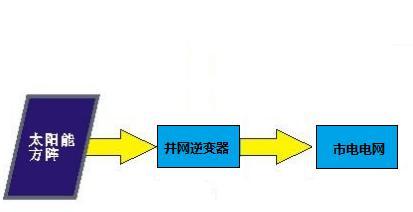
System Diagram 2
3 ) Solar-powered microgrid power generation system It consists of key components such as solar modules, an on-grid/off-grid integrated energy storage inverter, and energy storage batteries. Here’s how it works: The electricity generated by solar panels is directly converted into alternating current (AC) via the on-grid/off-grid integrated energy storage inverter, which then feeds into the AC busbar. Solar power is first used to meet the equipment’s energy needs, while any excess electricity is stored in batteries. Any remaining surplus is fed back into the utility grid. When the utility grid goes down, the system switches to backup mode, supplying power to the equipment either directly from solar energy or from the stored battery power—again through the same on-grid/off-grid integrated energy storage inverter. In this scenario, solar power continues to prioritize the equipment’s consumption, with any extra energy stored in the batteries. However, under these conditions, no power can be fed back into the grid.
Advantages : Solar power generation boasts high efficiency, stable output power, helps flatten peak demand and fill valleys, reducing strain on the grid—and ultimately maximizing profits for users.
Drawbacks: The system has high costs, Need to handle procedures with the NDRC and the power grid authorities.
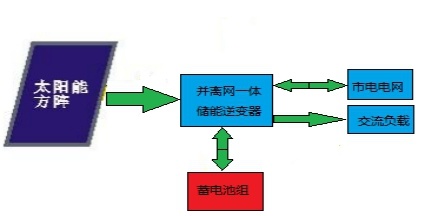
System Diagram 3
- Solar-powered direct current system : Composed of key components such as solar modules, a photovoltaic on-grid inverter, and energy storage batteries (which can be optional). The system works by converting the electricity generated from solar energy directly into alternating current via the on-grid inverter. Grid power and solar-generated electricity complement each other to supply power to the equipment—specifically, the system prioritizes using photovoltaic energy first. If the available solar power isn’t sufficient to meet local load demands, grid electricity steps in to fill the gap. In the event of a grid outage, the system seamlessly switches to solar power alone.
Advantages : High conversion efficiency, stable output power—even during grid outages the equipment continues to operate. With a high self-consumption ratio, it helps reduce strain on the power grid and lowers electricity costs, while eliminating the need for approval procedures with the NDRC and grid authorities.
Drawbacks: When the power grid experiences a blackout, the system’s load-carrying capacity matches the solar power generation output—meaning the electrical load cannot exceed the current solar power output (since the system is not equipped with energy storage batteries).
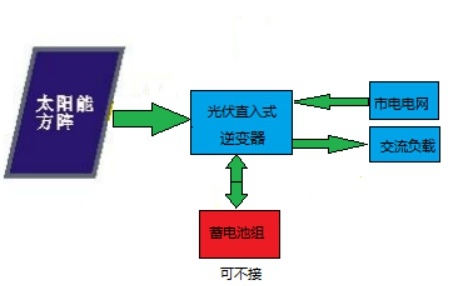
System Diagram 4
3、 Residential Building Solar Power Solution The choice
Photovoltaic power generation on the rooftops of residential buildings can be used to supply electricity for public facilities, such as lighting, surveillance systems, charging stations, access control, elevators, and more. It can also meet the energy needs of individual homeowners.
Based on the emerging trends in solar power applications, tailored to the development characteristics of the national grid.
It is recommended to prioritize solar microgrid power systems. The reason is that solar microgrids represent the most environmentally friendly solution. Not only do they boast high efficiency in solar power generation, but they also help flatten peak demand and fill valleys, thereby reducing strain on the grid. Additionally, integrating energy storage further enhances the system’s ability to support distributed energy resources.
Second, choose a grid-connected solar power system. The reason is that grid-connected systems require the least investment.
Once again, opt for a solar-powered direct supply system. The reason is that the investment is relatively low and the system is highly reliable.
Finally, choose a solar off-grid power system.
This article was compiled by Hepuyu New Energy. Please contact us in advance if you wish to reprint it. Thank you!
Related News

Add: No. 22 Tengren Road, Shunyi District, Beijing
Email: info@bjhpy.com
Consultation Hotline:
86-010-60480298

Follow us
Contact:
Email:
Tel:
WeChat:
在线客服添加返回顶部
右侧在线客服样式 1,2,3 1
图片alt标题设置: Helpyou New Energy
表单验证提示文本: Content cannot be empty!
循环体没有内容时: Sorry,no matching items were found.
CSS / JS 文件放置地